Soft-Pak Customer Acadiana Waste Featured In Waste Today
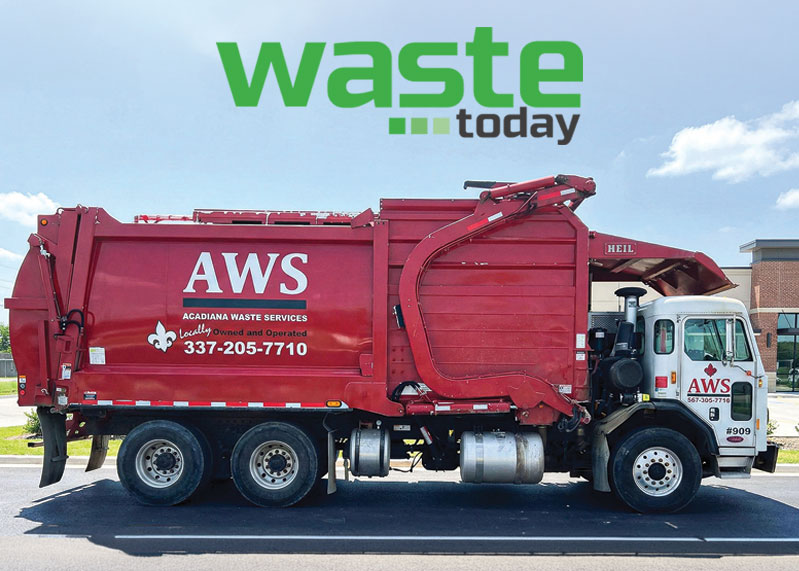
As seen in Waste Today – March 2026
From Paper Routes to Real-Time Visibility
Acadiana Waste Services leverages Soft-Pak to modernize operations at scale.
When Acadiana Waste Services LLC was awarded the residential contract for the city of Lafayette, Louisiana, in November 2023, growth accelerated quickly.
The contract added roughly 65,000 residential homes across Lafayette and surrounding unincorporated areas. At the same time, the company continued servicing more than 2,500 commercial front-load containers and about 600 roll-off containers throughout central Louisiana.
For the company, founded in 2012, the expansion was substantial. It marked a major milestone, but it also forced leadership to reassess how the operation was being managed.
“We knew pretty quickly that paper routes were not going to carry us through this next phase,” says Donald “Gus” Dugas, president and general manager of Lafayette-based Acadiana Waste Services. “At this scale, you need to see what is happening across the fleet in real time.”
Previous Success
Like many regional haulers, Acadiana Waste Services built its early growth on printed route sheets and dispatcher coordination. Drivers relied heavily on neighborhood familiarity, and navigation frequently came from personal cellphones. Work orders were printed using an entry-level software package. When a missed stop was reported, camera footage had to be pulled and reviewed manually.
The system worked when routes were smaller and density was lower. Dispatch could be managed through phone calls and check-ins. Supervisors addressed issues as they surfaced.
As route volume increased and municipal performance standards tightened, however, the strain became more evident. Breakdowns required manual reshuffling. Gaps with staffing created delays that rippled through the day. Verifying missed service claims took time, and under a city contract, time matters.
“It was not that we lacked information,” Bryce Gisclair, the company’s business analyst, says. “We had cameras. We had GPS. The issue was that everything operated in separate lanes.”
Leadership recognized that scaling successfully would require integrating those lanes.
Shift in Operating Model
Before committing to a digital platform, Acadiana Waste Services says it spent a significant amount of time evaluating its options. Company leaders spoke with other haulers, compared systems and focused closely on how each solution would perform under the demands of municipal contracts.
After that review process, Acadiana Waste Services implemented Soft-Pak’s back-office system ahead of the Lafayette residential rollout. Over the next year, routing became fully embedded in the company’s daily operations.
Printed route sheets were phased out and replaced with Soft-Pak’s Mobile-Pak tablets. Drivers now receive turn-by-turn navigation, live updates and real-time stop completion.
For drivers, the impact was immediate. Routes no longer depended solely on memory. Adjustments pushed directly to the cab. Stops updated automatically as work was completed.
For dispatch, the shift in operations was even more significant.
“We can see exactly where every truck is and how much work remains,” Dugas says. “If something changes, we adjust on the fly.”
Breakdowns no longer create hours of uncertainty. Stops can be reassigned within minutes. Route progress is visible throughout the day rather than having to be reconciled after trucks return to the yard. Instead of chasing information, the company’s dispatch team manages performance in real time.
Integrated Service Verification
One of the most meaningful improvements for the company has been in how service claims are handled.
Acadiana Waste Services had already equipped its fleet with 3rd Eye camera systems, which capture visual documentation of each collection event. Because 3rd Eye and Soft-Pak operate within Environmental Solutions’ Connected Collections ecosystem, routing, GPS and camera data function as a seamlessly integrated system rather than separate tools.
With its routing integrated, images automatically attach to individual stops. When a resident calls with a concern, customer service can immediately review time-stamped photo documentation tied directly to that address and service event within the Soft-Pak system.
Photos show whether the cart was serviced and, if not, provide clear documentation of the reason, such as a cart not being placed at the curb or container access being blocked.
“Before, we had to manually pull footage and search for the event,” Gisclair notes. “Now it is tied directly to the stop, which puts the information right at our fingertips.”
Geo-coded auto-completion further reduces manual input. When a truck enters proximity and the arm lift activates, the stop clears automatically. Drivers are not constantly tapping screens, and the system passively captures activity in the background.
Since full implementation, missed stops have declined sharply.
“Near elimination is not overstating it,” Dugas says of the company’s missed stops. “We are not rolling trucks back out nearly as often.”
Embracing the Technology
Technology only delivers results if drivers embrace it. According to company leadership, adoption has been strong across experience levels.
Tablet navigation allows drivers to run unfamiliar routes with real confidence. Coverage during vacations or absences is easier because route knowledge is not limited to a single individual.
“Life before and life after have been tremendously easier,” Dugas says. “Drivers are not worried about memorizing every street. The system guides them every step of the way.”
Onboarding has improved, as well.
“A new driver can step in and follow the route without worry from day one,” Dugas explains. “That shortens training time and improves consistency.”
Because many stops clear automatically through geocoded completion, tablet interaction is limited. Drivers remain focused on collection rather than administrative input.
Centralizing Routing Data
Operating under a municipal contract brings a great deal of scrutiny. Documentation matters. Response time matters.
Real-time visibility has reduced exposure to contract fines and strengthened communication with city officials. Leadership can reference specific stops, timestamps and photo documentation when questions arise.
The Soft-Pak system has also proven invaluable during storm response and debris collection.
“Storm cleanup moves fast,” Gisclair says. “You need to know what has been serviced and what has not. Real-time tracking gives us that clarity.”
Routes can be tagged and monitored digitally, allowing supervisors to track progress in real time while aligning data with municipal stakeholders.
With centralized route data, Acadiana Waste Services now reviews routing performance routinely. Stop density, travel patterns and completion times are analyzed and adjusted as needed. Rather than wait for complaints to show imbalances, supervisors identify inefficiencies using data.
“You can see which routes are overloaded and which are not,” Gisclair explains. “That helps us balance work more effectively.”
Routing is no longer a static plan. It evolves as the operation grows.
Continuous Improvement
The company continues to expand its digital capabilities.
Hopper cameras capture dumping events during recycling collection, while artificial intelligence tools flag contamination and tag accounts without requiring driver input. Leadership views these tools as practical ways to improve recycling outcomes while reducing manual data entry.
The company is also exploring digital systems for hazard tracking and enhanced storm-impact reporting, extending their role well beyond routine collection.
For Acadiana Waste Services, modernization is not a one-time initiative. It is an operating approach.
“We did not implement this just to say we have technology,” Dugas says. “We did it because our operation demanded it.”
The experience at Acadiana Waste Services reflects a broader shift across the waste hauling industry. As service expectations rise, paper-based routing becomes increasingly difficult to justify.
The cost of routing inefficiency shows up in repeat trips, excess fuel, labor hours and strained customer relationships. Greater visibility reduces those variables for companies.
By integrating routing and service verification through Soft-Pak, Acadiana Waste Services moved from reactive management to real-time oversight. Collection remains demanding work, but how that work is monitored, documented and adjusted has changed.
For waste hauling companies that continue to operate using printed route sheets, the question might not be whether modernization is necessary but when.